
Local Expertise
Low-Pitch Roofs and Gutter Slope in Summit County
September 29, 2026
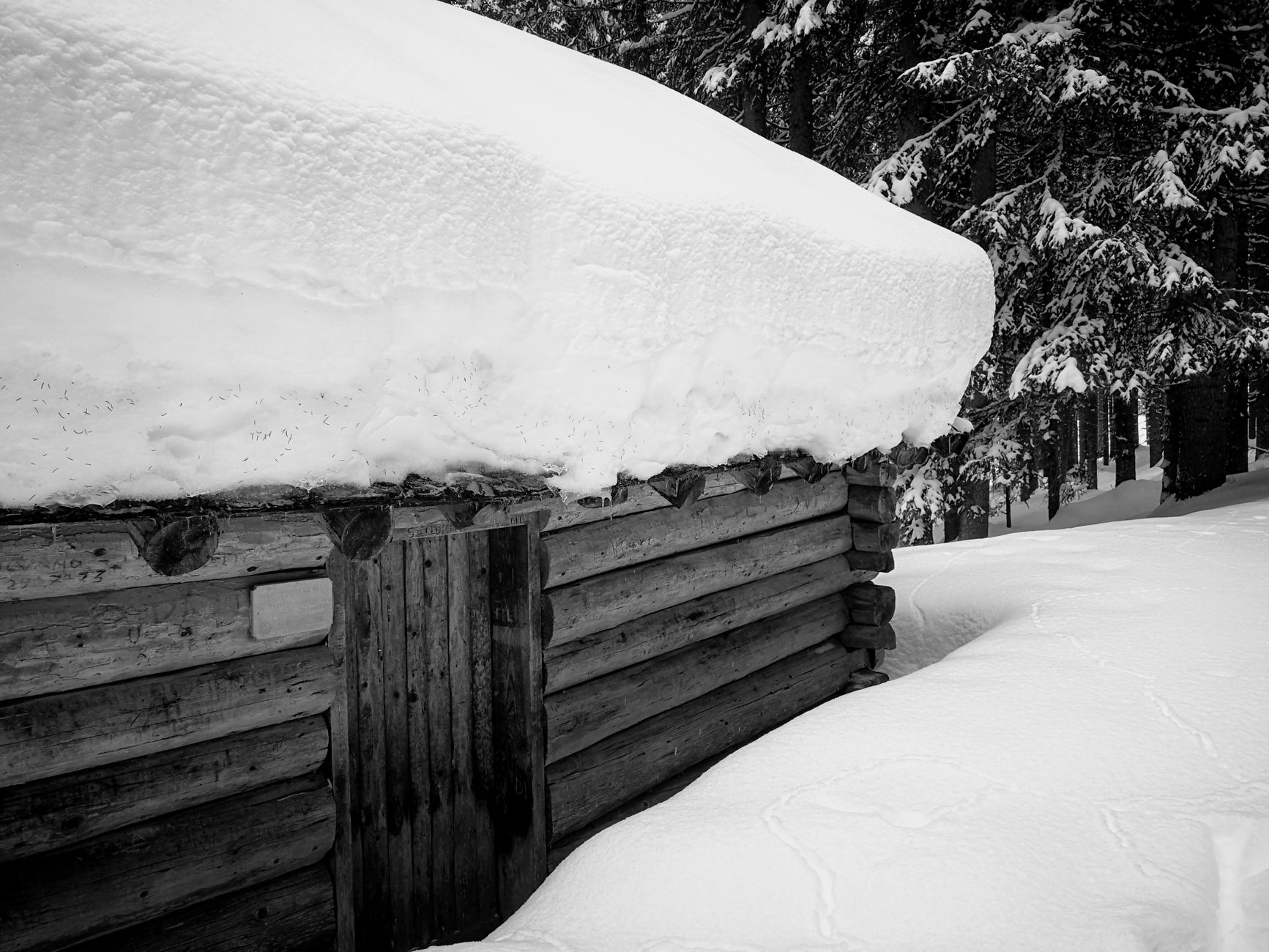
Walk a street in Frisco or the flatter parts of Dillon in late September and you'll see a lot of roofs that barely look like roofs. Shallow pitch, wide overhangs, long unbroken runs of gutter. They're built that way on purpose — a low-pitch roof holds snow instead of dumping it, which spreads the load and keeps the slide path off your front steps. It's a reasonable design decision at 9,000 feet.
It also changes everything about where Christmas lights can go.
Snow sits on a low-pitch roof, and your lights sit under it
On a steep metal roof, snow leaves. It releases in sheets, sometimes violently, and the lighting problem is anchoring hardware that survives a slide. On a low-pitch roof, snow stays. A four-inch storm in mid-November becomes an eighteen-inch pack by New Year's, compacting, melting at the deck from escaping heat, refreezing at the cold edge over the eave.
That refreeze at the edge is the ice dam, and on a low-pitch roof the dam has room to build wide instead of thin. Water backs up behind it. The gutter fills with ice and stops being a gutter — it becomes a trough of frozen weight hanging off your fascia.
Any light line clipped into that gutter is now inside the ice. Not on top of it. Inside. A C9 socket frozen into a solid block of ice doesn't fail dramatically; it just goes dark in mid-December and stays dark, because nobody is chipping ice out of a gutter on a ladder in January.
Gutter slope decides where the water — and the ice — collects
Gutters aren't level. They're pitched, usually something like a quarter inch of drop for every ten feet, running toward a downspout. On a house with a short gutter run and a steep roof, you barely notice. On a low-pitch roof with a fifty-foot front elevation and one downspout at the far corner, that slope matters a great deal.
Walk the line and you can usually see it. The gutter hangs closer to the fascia at the high end and drops away at the low end. Water — and meltwater from the snow pack above — travels that whole run before it exits. Everything freezes at the low end first, because that's where the standing water is.
So the correct answer to "where do the lights go" is not the same across the whole front of the house. Near the downspout end, where ice accumulates deepest and longest, the gutter lip is the worst available mounting surface. Twenty feet up-slope it may be perfectly fine.
What we look for on a site walk
- Where the downspouts are. They mark the low points. Those are the ice zones.
- Whether the gutter already shows damage. Bent hangers, a sagging mid-span, separated seams — all signs that last winter's ice load exceeded what the gutter was built for. Adding clips there means adding clips to something that's going to move.
- Heat cable. Plenty of Summit County homes have it in the gutters and along the eave. It changes where ice forms, and light lines need to be routed clear of it, not woven through it.
- The overhang depth. Wide eaves on low-pitch homes mean the shingle edge and the gutter lip are two very different mounting planes, several inches apart, with different exposure.
- Which direction the run faces. A south-facing eave in Silverthorne melts and refreezes daily through February. A north-facing eave just stays frozen. Different problems.
The shingle line is often the better line
On a low-pitch roof, moving the light line up off the gutter and onto the shingle edge usually buys you height above the worst of the ice. It also gives a cleaner sight line from the street, because on a shallow roof the viewer's eye catches the roof plane more than the fascia.
That said, shingle clips have their own rules. They need to sit under the shingle edge without lifting it, they need to be spaced tighter than the package suggests, and they can't be used at all on standing-seam metal — which shows up constantly on Summit County homes and rules out anything adhesive or anything that penetrates. Metal roofs get clamp-on hardware sized to the seam profile. No screws, no glue, no exceptions.
On a mixed roof — and half the houses in Breckenridge seem to be a mixed roof — one elevation gets shingle clips, another gets seam clamps, and a third gets a line run along a beam or a railing instead of the roof at all.
Wind pulls at the low end too
Lakeside properties in Dillon and anything on an exposed ridge in Silverthorne take sustained wind that a sheltered lot in the Frisco trees never sees. Wind grabs the slack between clips and works it. On a long, low-pitch run where the line is already carrying ice weight, slack plus wind is how a section peels off the eave and hangs down across a window.
The fix is boring: tighter clip intervals on exposed elevations, no slack in the run, and connections tucked where they aren't swinging free. It costs more clips and more time, and it's the difference between a display that looks the same in February as it did in November.
Lock in a design walk before the first real snow
None of this can be judged from a photo or a satellite view. Gutter slope, hanger condition, seam profile, heat cable routing, wind exposure — those get read standing on the property, and read best while the roof is still dry and bare.
That window closes fast. Once there's snow on a low-pitch roof, the eave edge is buried and the install gets slower for everyone. October and early November are when the good designs get drawn.
Summit Mountain Lights is based in Frisco, and the crew has been hanging lights on roofs like these for more than fifteen years. We design on-site, install with professional-grade materials, service the display through the season, and take it down in January. You don't touch a ladder. Tell us your address and roughly how many feet of roofline you're thinking about, and we'll put together a free estimate.